
Buying
Why Do Brentwood Homes Crack? The Clay Soil, Explained
There's a USDA soil series named Brentwood, and it's heavy clay that swells in winter and shrinks all summer. Which cracks that causes are normal, which aren't, and what a seller must disclose.
You walk out for the mail and there's a crack across the driveway you'd swear wasn't there in April. By the time you're back inside you've priced a new foundation in your head. That's the call I get this time of year, and most of the time the answer is reassuring. But "most of the time" isn't "always," and knowing the difference matters before you list, buy, or worry.
What soil is under a Brentwood home?
There's a soil series in the national USDA catalog called Brentwood, established in Contra Costa County in 1935. Its official type location is half a mile south of town, 180 feet west of Walnut Boulevard, next to an irrigation canal. The sample it was described from came out of an apricot orchard, which tells you what this valley was before it was subdivisions.
The USDA Official Series Description classifies it as "fine, smectitic." Smectite is the clay family most closely tied to swelling. A U.S. Geological Survey study found that the share of smectite in a material is a useful index of how much it will swell.
The Brentwood soil series, by the numbers
- Clay content: 35 to 40 percent, between 10 and 40 inches down
- Permeability: moderately slow, so water sits in the clay instead of draining off
- Rainfall: 12 to 20 inches a year
- Wet season: usually moist from early December until May, and dry the rest of the year unless it's irrigated
- Historic use: irrigated tree fruit, nut crops, vegetables, and field crops
It isn't the only soil in town. The same description lists Altamont soils on the uplands as a different series. But the Brentwood series is the one that shaped the orchards, and it's under a great many of our homes.
Why clay soil cracks concrete
The USGS defines expansive soils as soils that "shrink or swell as the moisture content decreases or increases." It adds that structures built on them can see shifting, cracking, and breaking damage.
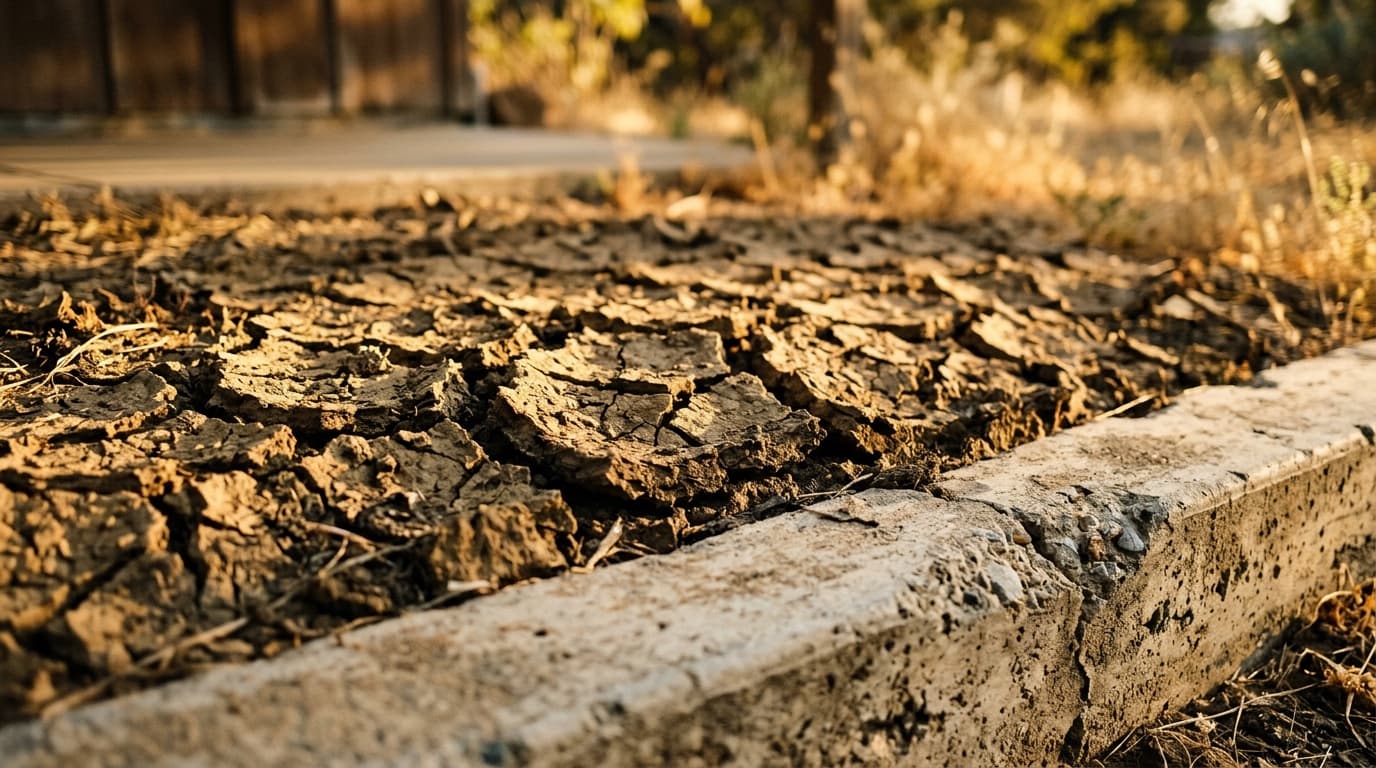
Now add our weather. The ground under your house runs on a yearly cycle. It takes on water through winter and pushes up. It gives that water back from late spring through fall and pulls down.
If that movement were perfectly even across the whole footprint, nothing much would happen. It never is. The shaded north side stays damper than the sunny south side. The corner with the downspout gets more water than the corner without one. A thirsty tree pulls moisture out of one edge. That difference — not the movement itself — is what stresses concrete.
That's why late summer and early fall are crack season. The soil has been drying since May, and by now it has pulled back about as far as it's going to.
Which cracks matter, and which don't?
I'm a broker, not an engineer, and I'll say that to anyone. But I worked lending, title, and escrow before I ever listed a house, and I know which inspection items make a lender nervous and which get initialed and forgotten.
Usually not alarming: hairline cracks in driveway or patio concrete. Fine cracks running from the upper corners of a door or window frame. Nail pops in drywall. Control joints in a garage slab doing exactly what they were cut to do.
Worth a second opinion:
- A crack you can fit a nickel into
- A crack with a lip, where one side sits higher than the other
- Doors or windows that stick in one part of the house but not another
- A stair-step crack through exterior stucco or block
- Separation where the garage slab meets the foundation
- Anything visibly wider than it was a year ago
That last one is the real test. A crack that holds still has settled. A crack that grows is active. If you own the home, photograph it with a coin beside it, write the date down, and do it again in six months. That one habit has saved my clients more argument in escrow than almost anything else I recommend.
What I watch for on Trilogy resales
What does a seller have to disclose?
California's Real Estate Transfer Disclosure Statement asks the seller directly whether they're aware of "any settling from any cause, or slippage, sliding, or other soil problems." The same section asks about fill and about "flooding, drainage or grading problems." A separate question lists foundation, slabs, driveways, and sidewalks by name. The form is set out in Civil Code section 1102.6, and the Department of Real Estate reprints it in its disclosure booklet.
The part sellers get backwards: the question isn't whether a crack is structurally serious. It's whether you're aware of it. If you had the driveway leveled a few years ago, that's a yes. If you've been watching a hallway crack for three years, that's a yes. You aren't certifying that the house has a problem. You're reporting what you know.
Disclosing is the inexpensive move. Leaving it off is the expensive one, and it's what most often follows a seller after closing. I'd rather write it up front and price it in than watch it surface during the buyer's inspection and cost us leverage mid-negotiation. The escrow timeline post shows where that inspection lands.
Keeping the moisture even
Every item here comes back to one idea: keep the moisture around the house as even as you can.
- Point downspouts away from the foundation, not into the planter beside it
- Keep the ground sloping away from the house
- Don't let sprinklers soak one side while the other bakes
- Think twice before planting a large, thirsty tree close to the slab
- When you start watering a parched yard again, ease into it instead of flooding it all at once
None of this is expensive. All of it's easier to do now than to explain to a buyer's inspector later.
Have a crack you're wondering about? Text me a photo with a coin next to it. I'll tell you plainly whether it needs a specialist or can be forgotten, and there's no charge for the opinion. If you're thinking of selling, this is worth sorting out before the sign goes in the yard.
Call or text (925) 200-0717. I answer my own phone, seven days a week.
This post is general information, not legal, tax, engineering, or insurance advice. Soil and foundation conditions vary lot to lot. For a specific property, talk with a licensed structural engineer and your own attorney or tax advisor.
Margie Lupo, Broker Associate, SRES® · eXp Realty of Northern California, Inc. · DRE #01193496 · Brokerage DRE #02188495 · Equal Housing Opportunity
Sources
- USDA NRCS, Official Series Description — Brentwood Series — taxonomic class, clay content, permeability, rainfall, moisture season, type location, use, associated soils. Accessed October 2026.
- U.S. Geological Survey, Landslides Glossary — "expansive soils." Accessed October 2026.
- U.S. Geological Survey, Mineralogy and swelling-potential relationships of expansive shales — smectite content as an index of swelling potential. Accessed October 2026.
- California Department of Real Estate, Disclosures in Real Property Transactions — Real Estate Transfer Disclosure Statement (Civil Code § 1102.6), Section II, items B and C.6–C.8. Accessed October 2026.
- California Department of Insurance, Consumer Fact Sheet on Insurance Coverage for Flood, Mudflow, etc. — standard homeowners policy exclusions. Accessed October 2026.
- Fannie Mae Selling Guide, B4-1.3-06, Property Condition and Quality of Construction — appraisal reporting of structural deficiencies. Accessed October 2026.
Frequently asked questions
Does clay soil hurt resale value?
Not on its own. Expansive soil is a general condition here, and Brentwood buyers run into it on nearly every home they tour. What hurts value is an active problem nobody disclosed, or a cosmetic one the seller didn't mention and the buyer found anyway.
Should I get a foundation inspection before I list?
If a crack matches anything on the second-opinion list above, yes. A licensed structural engineer's letter saying the movement is cosmetic and stable turns an open question into a closed one before an offer is ever written.
Will the appraiser care?
For a loan sold to Fannie Mae, the appraisal must describe deficiencies that could affect a home's soundness or structural integrity. If the appraiser can't judge them, the report can be made subject to an inspection by a qualified professional. That rarely kills a deal, but it can delay one, and a delay two weeks before closing is its own kind of expensive.
Will homeowners insurance cover it?
Usually not. The California Department of Insurance lists settling, cracking, shrinking, and expanding or contracting of earth among the standard exclusions in homeowners policies. Read your own policy and ask your agent directly.
Keep reading
Other guides from this desk


Have questions about Brentwood real estate?
Let's talk about your next move. I'll get back to you personally. Coffee in Downtown Brentwood works too.
I answer my own phone, seven days a week.